Dickson Hill Garage Door Repair Co.
Issue 2 of 3Garage DoorsMarkham, Ontario
Garage Door Panel Replacement: what the visit covers
A sectional garage door is built from four or five horizontal sections joined by hinges, each riding on its own rollers in the tracks.
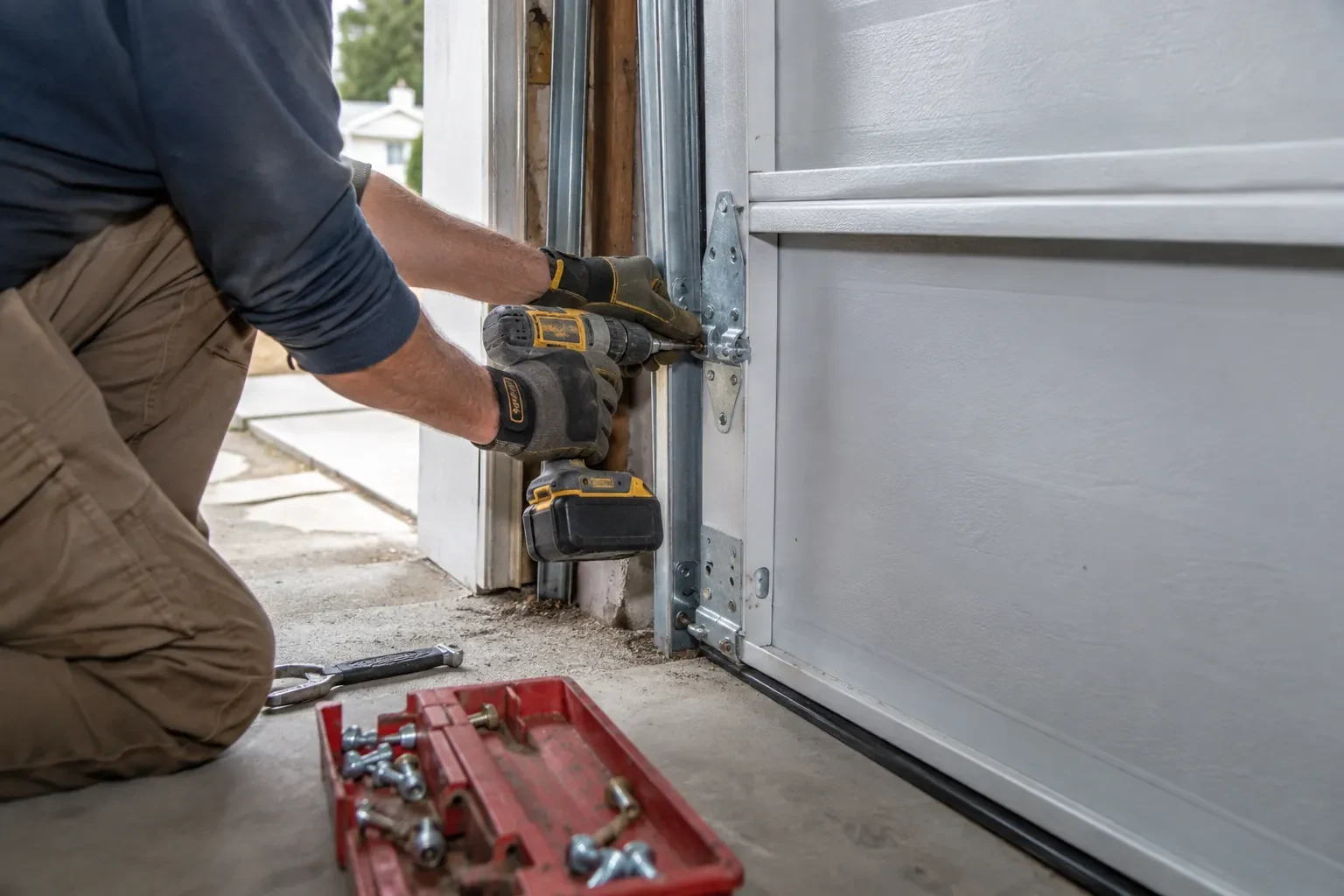
A sectional garage door is built from four or five horizontal sections joined by hinges, each riding on its own rollers in the tracks. Panel replacement takes advantage of that design: when one section is creased, rusted or cracked, it can be unhinged and swapped for a new section of the same make, model and size while the rest of the door stays where it is. The technician identifies the door, confirms a matching section is available, holds the door secure in its tracks, exchanges the section with any bent hinges or rollers, and then re-checks alignment, balance and the opener before handing the door back.
Which position took the hit
Bottom, middle and top sections are different parts with different jobs, and the position sets the shape of the repair. A bottom section carries the lift cables through its bottom brackets, so replacing it means unloading the springs first. A top section carries the opener arm bracket and the top roller fixtures, so its replacement includes resetting how the opener pulls. An intermediate section carries only hinges and rollers and is the simplest exchange. The technician also checks whether the damaged section is a special one, such as a glazed section or one with a factory strut, because it is ordered as that exact position and type.
Releasing tension for a bottom section
The bottom section is the one place where the lift cables attach, and those cables are held taut by the springs. Before its brackets are unbolted, the technician takes the energy out of the system. On a torsion door that means fitting winding bars into the cone and unwinding the spring turn by turn while the set screws are loosened; on an extension-spring door it means propping the door open and unhooking the springs. With the cables slack, the bottom brackets, the seal retainer and the section itself can be removed safely. The same steps are reversed at the end, and the door's balance is set fresh.
Keeping ice away from the bottom section
Since a bottom section frozen to the slab is the commonest way one gets bent, a few winter habits protect the new one. Sweep snow away from the outside of the door before it turns to slush and freezes under the seal. A light wipe of silicone on the new astragal helps it release from ice. If the door refuses to move on a cold morning, free the seal from the floor with warm water or a scraper before running the opener rather than letting the motor pull against it. A well-fitted bottom seal also keeps meltwater from wicking under the door in the first place.