Openers · Markham
Belt-Drive Opener Repair
After the power came back you pulled the red cord to get the car out. Since reconnecting, the door stops short of the floor, and no amount of turning the limit adjustment brings it the rest of the way down.
Belt-Drive Opener Repair
In plain words
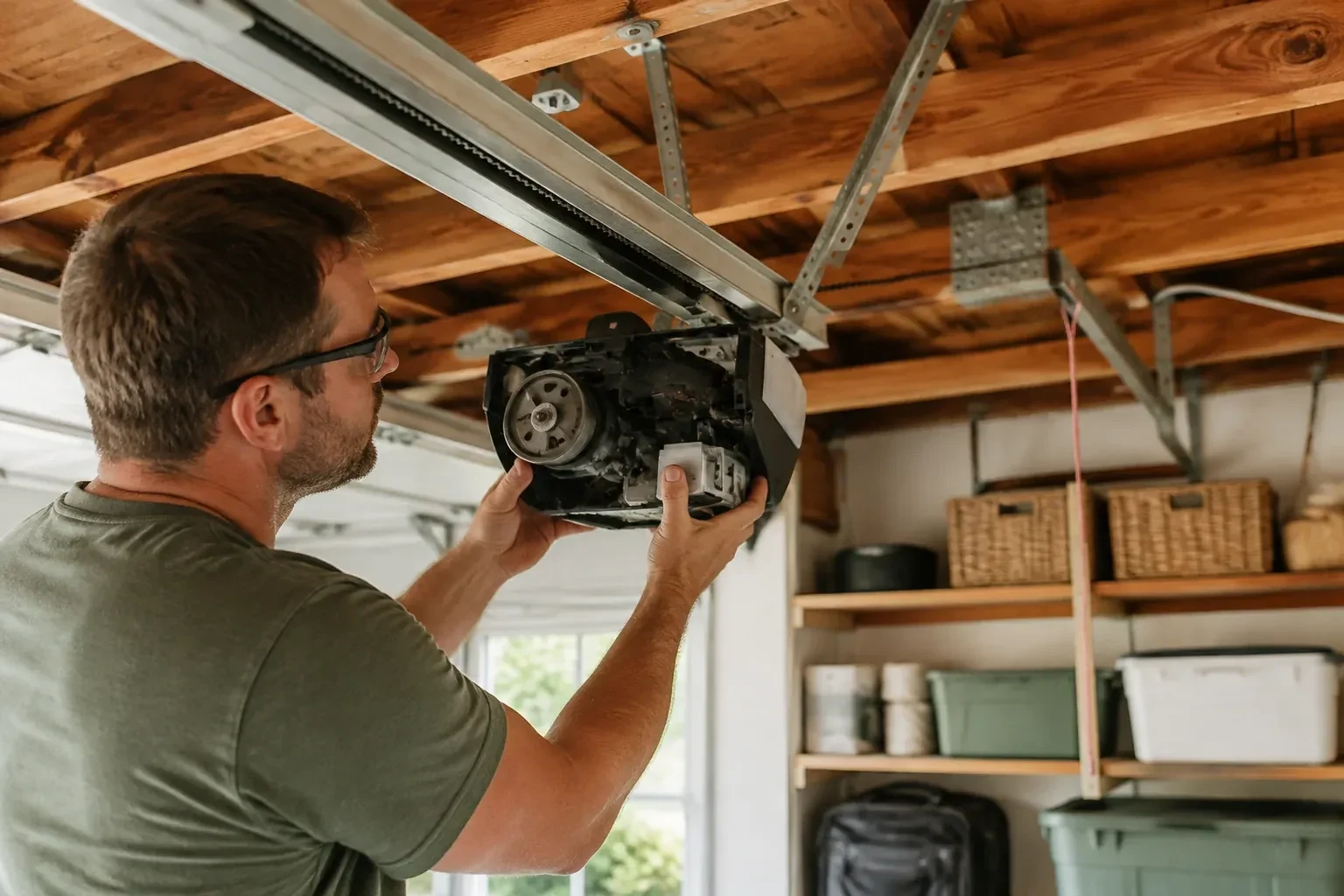
After a belt has been off the sprocket, the operator can end up out of phase: the motor thinks the door is somewhere the trolley is not. The symptom is a door that stops short at the top or the bottom no matter how the limits are adjusted, or a trolley that bangs into its stop bolt. The correction is part of every belt repair. With the belt lifted off the sprocket, the operator is run until the sprocket settles at its closed position; the belt is refitted with the trolley at the closed end; then travel and force are relearned so motor and trolley agree again.
How the visit goesSomeone tightened the belt last month to stop the sag. Now the opener sounds like a chain drive, the motor labours on the way up, and the whole rail vibrates under the ceiling.
Markham
How the visit goes
The trolley and its release
The trolley turns the belt's pull into movement of the door and takes every start and stop. The technician checks its two halves: the inner half the belt is fixed to, and the outer half the door arm hangs from. The release lever should part them cleanly when the cord is pulled and lock them together again when the operator runs or the cord is pulled a second time. Cracks in the housing, a lever gummed with old grease, play on the rail, or a trolley sitting hard against a stop bolt are all noted. Whether trolley and motor are in step is checked too, since a belt that has been off the sprocket often leaves them disagreeing.
Putting motor and trolley back in step
Any time the belt has been off the sprocket, the operator's sense of where the door is can drift from where the trolley actually sits, so this step is done before the door is reconnected. The technician lifts the belt clear of the sprocket, runs the operator until the sprocket turns to its closed position and stops on its own, then slides the trolley to the closed end of the rail and refits the belt. Motor and trolley now agree. On operators with a mechanical limit assembly, the middle contact is adjusted instead. Without this step, the door stops short at one end no matter how the travel limits are turned.
A door that is balanced under a belt that is right
Because the door was tested by hand before the belt was touched, you leave with the springs and the drive in agreement. Once a season, with the door closed, unplug the operator, pull the release and lift the door to about a metre: it should stay there. If it drifts down or creeps up, the springs have moved and the belt will soon be working harder than it should, so book a spring adjustment before the belt shows it. A door that hesitates at one point in its travel with the operator disconnected is telling you about a roller or a hinge rather than the belt, and that too is a small visit.
Belt-Drive Opener Repair
In the van
- Idler pulley and bearing
- Door arm and clevis pins
- Light grease for the drive gear
- Rail hanger straps and fasteners
- Belt tension spring and square nut
What affects the quote
Same fees day, night or weekend
1Age and model of the operator
Parts for a current model are on the van. An older or less common operator may need a belt or trolley ordered to fit, which changes timing and sometimes the part.
2Door size and weight
A wide double door or a heavy insulated one asks more of the belt and trolley, and the inspection may point to a suitably rated opener or a top-section strut for that door, alongside the belt matched to the rail and sprocket.
3When you call
An evening, weekend or holiday visit costs the same amount as a weekday one for a belt-drive repair. The technician looks at the belt, trolley and rail once on site, and the exact figure follows from what is actually found, not from the day of the week.
Belt-Drive Opener Repair: questions
Is a belt drive harder to repair than a chain drive?
No, just different. The belt is lighter, runs dry and is replaced as one length with a clip, where a chain has links and takes grease. The tensioning at the trolley works the same way on both, and the sprocket, idler and trolley are similar parts. What a belt drive rewards is care with tension and a straight rail, because it is chosen for quiet and shows any fault as noise.
What are the signs a belt is wearing out?
Cracks across the back of the rubber, a shiny glazed surface, a fuzzy or frayed edge, teeth worn flat or torn away in a stretch, and cords showing through the rubber. The clip at the trolley can also go brittle and snap. Most belts show one of these long before they fail, which is why a glance along the rail every few months catches a repair early.
How often should belt tension be checked?
A look every few months is enough: with the door closed and again with it open, the belt should run level with no sag below the rail. A yearly service that checks tension against the spring length, looks at the sprocket and pulley and runs the balance and reversal tests keeps a belt drive quiet for its whole life. Check again after the first hard cold of the winter.
Openers & Access
- Chain-Drive Opener RepairThe chain in the detached garage went orange with rust over the winter, the links are stiff, and…
- Garage Door Opener ReplacementYou swapped the old wooden door for a heavier insulated steel one, and the twenty-year-old opener…
- Photo-Eye Sensor Alignment or ReplacementThere are no sensors at the floor at all, or a previous owner has wired the pair together up beside…
Belt-Drive Opener Repair near you
Garage door work for Markham divides neatly into what we fix, what we replace and what we install. We fix tracks, hinges, openers and panels; we replace springs, cables, rollers, seals and sensors; and we install new doors, new openers and access equipment such as keypads and smart controllers.